Sale!

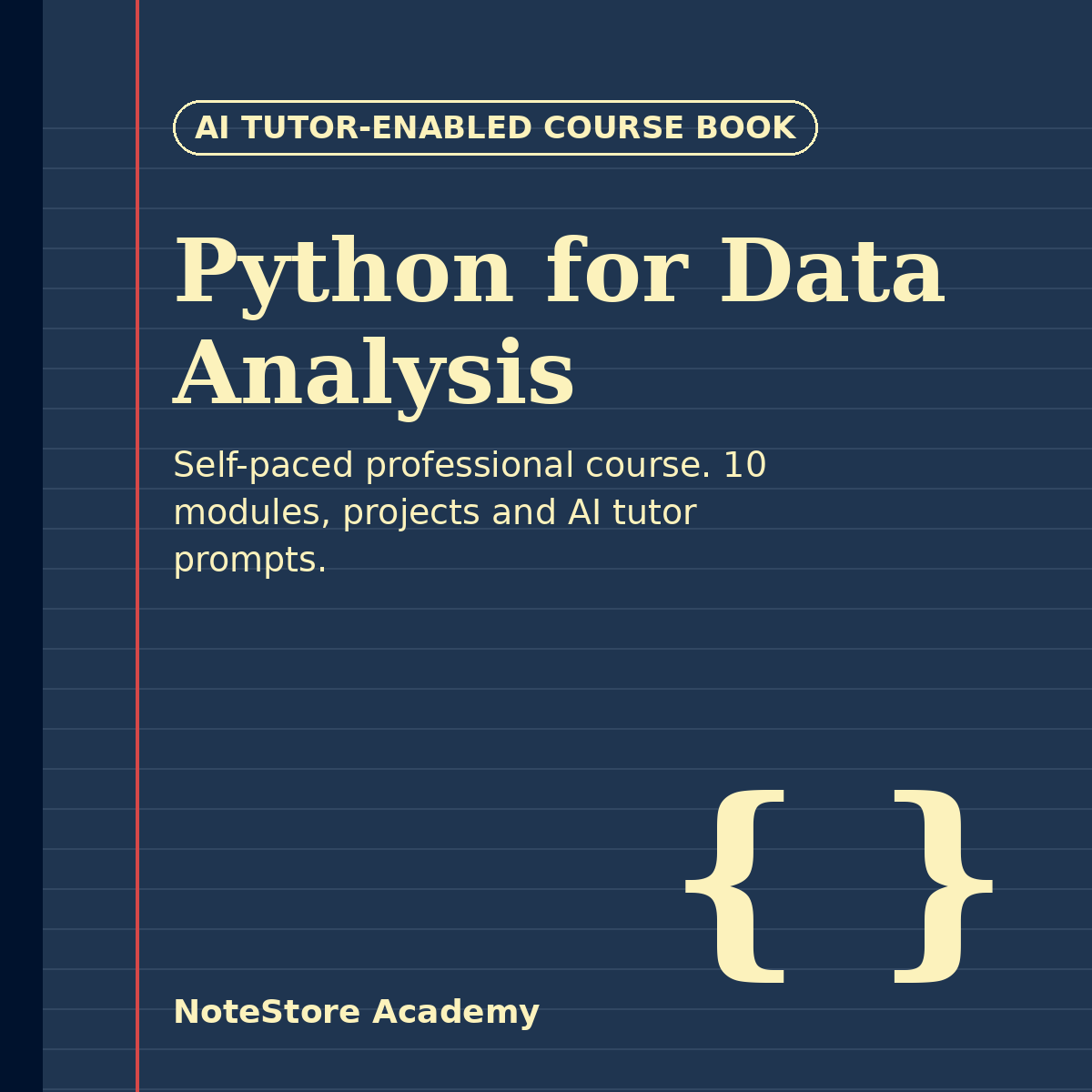
Python for Data Analysis: pandas, Visualisation and Real Projects – AI Tutor-Enabled Course Book

Original price was: $55.00.Current price is: $45.00.

  • AI Tutor-enabled
  • Self-paced
  • Beginner → Intermediate
Modules
10
Study time
About 40 hours
Format
Digital course book (PDF)
Projects
4 + capstone

Read a free preview

Go from your first line of Python to cleaning, analysing and visualising real datasets.

TypeNotes & books
DeliveryInstant download after payment
  • Instant download after payment
  • Lifetime access in My Courses
  • Secure checkout

AI Tutor-Enabled Self-Paced Professional Course Book

Go from your first line of Python to cleaning, analysing and visualising real datasets.

Python for Data Analysis is a self-paced course book that teaches Python fundamentals, then applies them with NumPy, pandas, Matplotlib and seaborn to clean, analyse and visualise data. Every module ends with hands-on exercises using realistic datasets.

Is this you?

  • Spreadsheets slow you down on bigger datasets
  • Coding tutorials stop before real projects
  • pandas errors are confusing
  • You copy code without understanding it
  • Your charts do not tell a clear story
  • You want a data portfolio for job applications

This course book is built to close exactly that gap: clear explanations, worked practice and an AI tutor that guides you instead of just giving answers.

  1. Learn
  2. Practise
  3. Check with your AI Tutor
  4. Build projects
  5. Get assessed

What you’ll learn in 10 practical modules

01 Python FoundationsWrite your first programs.

Key concepts

  • Variables and data types
  • Conditionals and loops
  • Functions

Sample practice

  • Write a function that returns the average of a list
  • Count vowels in a string
02 Working with Data StructuresStore and organise data.

Key concepts

  • Lists and dictionaries
  • Comprehensions
  • Reading and writing files

Sample practice

  • Count word frequencies with a dictionary
  • Read a CSV with the csv module
03 NumPy EssentialsCompute fast with arrays.

Key concepts

  • Arrays and vectorisation
  • Indexing and slicing
  • Basic statistics

Sample practice

  • Compute column means of an array
  • Standardise an array
04 pandas DataFramesLoad and explore tabular data.

Key concepts

  • Series and DataFrames
  • Selecting and filtering
  • Sorting

Sample practice

  • Load a CSV and show the top 5 rows by sales
  • Filter rows by two conditions
05 Cleaning DataFix messy real-world data.

Key concepts

  • Missing values
  • Duplicates and data types
  • String and date cleaning

Sample practice

  • Fill or drop missing values and justify the choice
  • Convert a text column to dates
06 Transforming and CombiningReshape and join datasets.

Key concepts

  • groupby and aggregation
  • merge and concat
  • pivot tables

Sample practice

  • Total sales by region and month
  • Merge customers with orders
07 Data VisualisationTell stories with charts.

Key concepts

  • Matplotlib basics
  • seaborn statistical plots
  • Choosing the right chart

Sample practice

  • Plot monthly revenue as a line chart
  • Make a correlation heatmap
08 Exploratory Data AnalysisInvestigate a dataset systematically.

Key concepts

  • Distributions and outliers
  • Relationships between variables
  • Writing up findings

Sample practice

  • Write five findings from an EDA
  • Detect outliers with the IQR rule
09 Introduction to Statistics and Modelling in PythonAdd simple models to your analysis.

Key concepts

  • Descriptive statistics with pandas
  • Correlation and linear regression
  • Train and test split

Sample practice

  • Fit a linear regression with scikit-learn
  • Interpret the model coefficient
10 Automating and Sharing AnalysisMake your work repeatable.

Key concepts

  • Jupyter notebooks
  • Writing reusable scripts
  • Exporting reports

Sample practice

  • Turn a notebook into a script
  • Export results to Excel

Use AI as your personal tutor, not an answer machine

The course book includes ready-to-use prompts for ChatGPT, Copilot, Gemini or any capable AI assistant. Each mode makes the AI teach, guide, check or challenge you, so you build real understanding.

1TEACH ME

Explain [topic] in Python for Data Analysis to me step by step at a [beginner / intermediate / advanced] level. Use a simple example first, then a harder one, and ask me a question to check I understood.
2GUIDE ME

I am working on this problem: [paste problem]. Do not give me the answer. Give me one hint at a time and wait for my next step.

3CHECK MY WORK

Here is my solution: [paste working]. Check each step, tell me exactly where any mistake is and why, but let me correct it myself.

4CHALLENGE ME

Give me three exam-style Python for Data Analysis questions on [topic], getting harder each time. Wait for my answers, then mark them and explain what I missed.

5HELP ME APPLY IT

Show me how [topic] from Python for Data Analysis is used in a real situation, then give me a small task to try it myself.

Verify before you trust

  1. Ask a clear, specific question
  2. Solve it yourself first
  3. Test the answer by substituting or estimating
  4. Check it against the worked examples in the book
  5. Validate with your teacher if the AI and the book disagree

Don’t just study it. Build evidence you can show.

Project 1

Sales Dashboard Analysis

Clean and analyse a retail sales dataset.

Project 2

Public Health Data Study

Explore trends in an open health dataset.

Project 3

Customer Segmentation

Group customers by behaviour with pandas.

Project 4

Automated Report

Build a script that produces a weekly summary.

Final capstone

End-to-End Data Analysis Portfolio Project

Choose a public dataset, analyse it and publish a notebook and short report.

Who this course book is for

  • Complete beginners to coding
  • Students in any field
  • Excel users moving to Python
  • Junior analysts
  • Researchers
  • Career changers into data

Where these skills lead

  • Data analysis
  • Business intelligence
  • Data science
  • Research
  • Marketing analytics
  • Operations

The course builds skills and evidence; it does not guarantee employment or exam results.

What you receive

  • 10 progressive learning modules
  • Learning objectives, key concepts and practice problems
  • Ready-to-use AI Tutor prompts for five learning modes
  • Practical projects and a capstone
  • Portfolio guide, assessment rubric and completion checklist
  • Instant download and lifetime access in My Courses
FormatDigital course book (PDF)
Learning modeSelf-paced + AI Tutor
LevelBeginner → Intermediate
Study timeAbout 40 hours
Created byNoteStore Academy
CertificateOptional project and portfolio assessment
LicencePersonal learning use
UpdatedNovember 2, 2026

Certificate pathway

Want a certificate? Submit your work for optional assessment by NoteStore Academy. Certificates reflect demonstrated work, so they are not issued automatically with purchase.

Module practice work20%
Projects 1–440%
Capstone project30%
Portfolio and reflection10%

Frequently asked questions

Do I need coding experience?

No. Module 1 starts from zero.

What software do I need?

Python with Jupyter (free via Anaconda) or Google Colab in your browser.

Are datasets included?

The book links to free public datasets and shows how to create practice data.

Will I have a portfolio at the end?

Yes. The four projects and capstone are designed to be shared on GitHub.

How do I get the course book after paying?

Your download link appears on the order confirmation page straight away, is emailed to you, and stays in My Courses in your account.

Which AI assistant can I use?

Any capable assistant works, such as ChatGPT, Microsoft Copilot or Google Gemini. The prompts are written to work with all of them.

Start today

Python for Data Analysis: pandas, Visualisation and Real Projects

Self-paced, AI Tutor-enabled and project-based. Download instantly after payment and keep it in My Courses.

Original price was: $55.00.Current price is: $45.00.

Read a free preview first
Secure checkout by AgentaOS Secure checkout by AgentaOS